
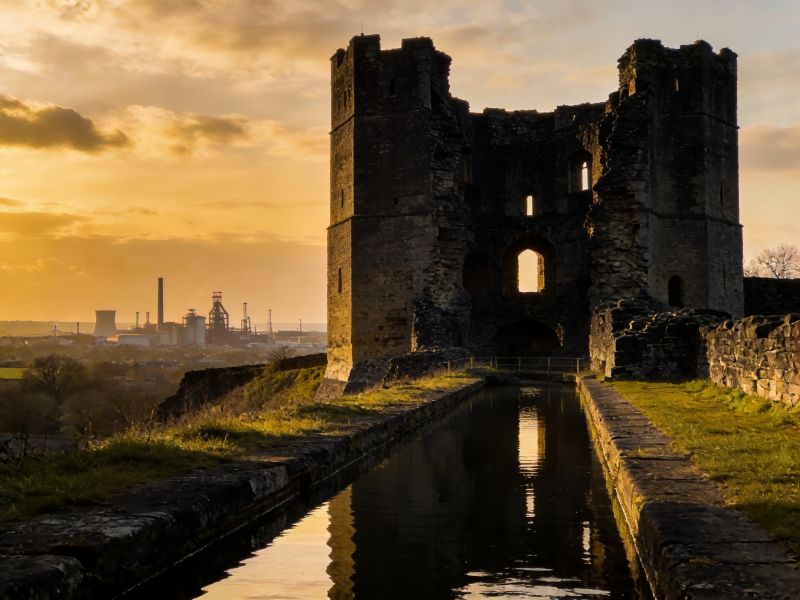
Dudley doesn't dress itself up for visitors. The first thing you notice from the train window is the jagged skyline of industrial units and the blunt silhouette of the castle keep, squatting on its hill like it's dared anyone to move it. A friend from London once asked me if there was 'anything there.' I told him there was everything that mattered and nothing that glittered. He didn't get it. Most people don't until they've spent an afternoon in the town centre, watching the market traders pack up their stalls while a pensioner argues about the price of a cabbage.The castle is the obvious anchor—Dudley Castle, half-ruined, its limestone walls stained black by centuries of coal smoke. Zoological gardens sprawl below it now, a strange pairing of medieval masonry and lemur enclosures that somehow works. I climbed the keep last November, wind cutting across the ramparts, and looked down at the patchwork of rooftops and retail parks. You can see the whole town from up there, and the whole town can see you. That exposure feels honest. Dudley doesn't have the curated charm of a Cotswold village or the self-conscious cool of a Manchester Northern Quarter. It has a canal basin where herons stalk the towpath, a museum dedicated to glass that still smells faintly of furnace heat。and a football club that has known far more relegation battles than glory.What strikes me about Dudley is the stubbornness of its local identity. The Black Country dialect—'yow' for you, 'bostin' for great—hasn't been sanded down by commuter belts or creative-class migration. People still say what they mean. A butcher on the high street once told me, unprompted, that his sausages were 'better than anything you'll find in Birmingham, and cheaper than you deserve.' That's Dudley in a sentence: self-deprecating, faintly confrontational, quietly proud. The town has taken its lumps—the decline of manufacturing hit hard in the 1980s, and some streets still wear that scar tissue—but it hasn't collapsed into nostalgia or self-pity. The glass industry, once the town's lifeblood。survives in smaller workshops and a museum that actually does the work of explaining why it mattered.
There's a particular stretch along the Dudley Canal where the water turns a deep, opaque green and the brickwork of old wharves crumbles into the towpath. I walk it most weeks. It's not pretty in any conventional sense. There's graffiti on the bridge supports, a shopping trolley half-submerged near the lock, and the constant low hum of the nearby ring road. But herons nest in the trees, and in summer, kids fish for roach with bamboo poles. That coexistence—dereliction and life, noise and stillness—captures Dudley better than any tourist brochure ever could. The town doesn't pretend to be something it isn't。and that lack of pretence is oddly comforting.Dudley won't make anyone's list of must-see destinations. It lacks the photogenic drama of a coastal town or the cultural weight of a cathedral city. What it has instead is a kind of unvarnished reality—a place where the past isn't curated but simply present, where the people are as blunt as the architecture, and where a ruined castle shares a postcode with a zoo and a canal full of herons. That's not a pitch. That's just Dudley. You either get it or you don't, and honestly。the town doesn't seem to care much either way.